Case Study
Industrial Internet of Things - Cellular to Azure
Led a team of 5 developers and systems analysts in a year-long initiative to design and implement an IIoT proof of concept, enterprise strategy, and technical standards for secure, scalable data collection from remote field devices.
IIoT
Azure Cloud
Cellular Connectivity
MQTT
Serverless
Enterprise Strategy
Executive Snapshot
Objective
Design and implement a secure, scalable IIoT solution for collecting field data from remote edge devices, establishing enterprise strategy and technical standards for future deployments.
My Role
Lead Developer & Systems Architect. Led 5-person team; designed architecture, implemented proof of concept, and established enterprise IIoT strategy and technical standards.
Duration
~1 year (strategy → proof of concept → standards)
Scope
Enterprise-wide IIoT strategy • Remote field devices • Real-time data collection • Azure cloud integration
Architecture
Edge Devices → Cellular → Azure IoT Hub → Azure Functions → Messaging Queues → Data Processing
MQTT Protocol
Cellular Connectivity
Azure IoT Hub
Azure Functions
TLS Certificates
Enterprise Security
Outcome
- Successfully developed a secure solution for collecting field data from remote edge devices.
- Established comprehensive enterprise IIoT strategy and technical standards for future projects.
- Implemented serverless data processing using Azure Functions and messaging queues.
- Enabled scalable, real-time data integration with Azure IoT Hub.
The solution established a foundation for future IIoT deployments across the organization.
Problem
The organization needed to establish a secure, scalable foundation for Industrial Internet of Things (IIoT) deployments. Remote field devices required reliable data collection capabilities, and the enterprise lacked standardized approaches for IIoT architecture, security, and data processing. There was a need for a proof of concept that could serve as a template for future IIoT initiatives.
Solution
- Designed and implemented a cellular-based IIoT architecture for remote field device connectivity.
- Utilized MQTT protocol for efficient, lightweight messaging between edge devices and cloud.
- Implemented Azure IoT Hub for device management, authentication, and data ingestion.
- Built serverless data processing using Azure Functions and messaging queues.
- Ensured enterprise-grade security with TLS certificates and robust authentication.
- Established technical standards and best practices for future IIoT deployments.
Architecture
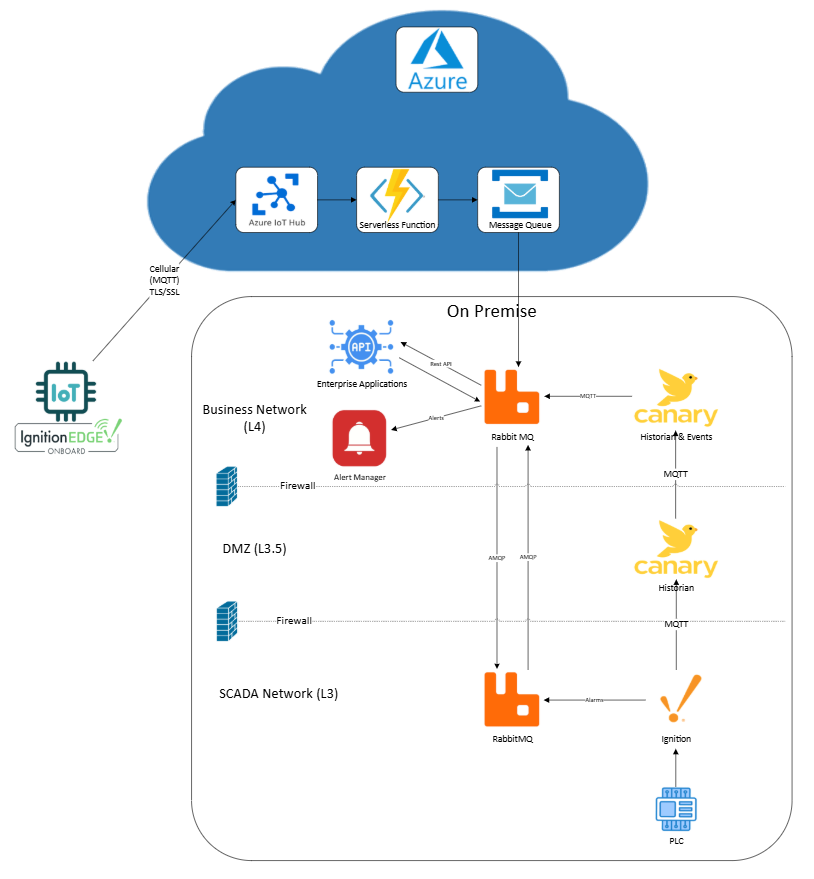
Standards: Enterprise IIoT best practices. Security: TLS encryption, certificate-based authentication, secure device provisioning.
Technologies & Components

MQTT Protocol

Cellular Connectivity

Azure IoT Hub

Azure Functions

Messaging Queue
TLS Certificates
Key Features & Achievements
| Feature | Description | Benefit |
|---|---|---|
| Secure Field Data Collection | Developed a secure solution for collecting field data from remote edge devices using cellular connectivity. | Reliable data acquisition from remote locations with enterprise-grade security. |
| Enterprise IIoT Strategy | Established comprehensive enterprise IIoT strategy and technical standards for future projects. | Standardized approach for all future IIoT deployments across the organization. |
| Serverless Data Processing | Implemented serverless data processing using Azure Functions and messaging queues. | Scalable architecture with automatic scaling and cost optimization. |
| Real-time Integration | Enabled scalable, real-time data integration with Azure IoT Hub. | Immediate insights and responsive system behavior. |
- Enterprise IIoT strategy development and stakeholder alignment.
- Architecture design and proof of concept implementation.
- Security framework and technical standards establishment.
- Documentation and knowledge transfer for future deployments.
- You: Lead Developer & Systems Architect, overall project leadership and technical direction.
- Developers (3): Implementation, testing, and integration of IIoT components.
- Systems Analysts (2): Requirements analysis, documentation, and standards development.
- Security-first approach: TLS certificates and robust authentication are essential for IIoT deployments.
- Scalability planning: Serverless architecture provides flexibility for future growth.
- Standards matter: Establishing technical standards early enables consistent future deployments.