Modern Data Operations - OT to IT Integration
Designed and implemented a proof of concept for modern data operations using Ignition (Inductive Automation) with MQTT, establishing a standard structure for data flowing from Operational Technology (OT) to Information Technology (IT) with enterprise-grade security and scalability.
Executive Snapshot
Outcome
- Successfully tested 1000 tags writing to the historian at a frequency of 20ms each without significant server or database performance impact.
- Established enterprise-wide data ops strategy for contextualized, structured OT data collection.
- Implemented SAML-based SSO with Active Directory integration for role management.
- Created ISA-95 compliant asset hierarchy and MQTT topic structure.
Problem
The organization needed to establish a modern data operations strategy for collecting Operational Technology (OT) data in a contextualized, structured fashion. There was a lack of standardized approaches for OT to IT integration, with challenges around scalability, security, and data organization. The goal was to determine an enterprise-wide data ops strategy that could handle high-frequency data while maintaining security and usability.
Solution
- Implemented Ignition (Inductive Automation) as the core platform for OT to IT integration.
- Established MQTT-based communication with SparkplugB specification for structured messaging.
- Created ISA-95 compliant asset hierarchy and MQTT topic structure for standardization.
- Implemented SAML authentication with Active Directory integration for enterprise SSO.
- Configured TLS certificates and secure ports for encrypted communications.
- Integrated with Seeq analytics platform for data visualization and analysis.
Architecture
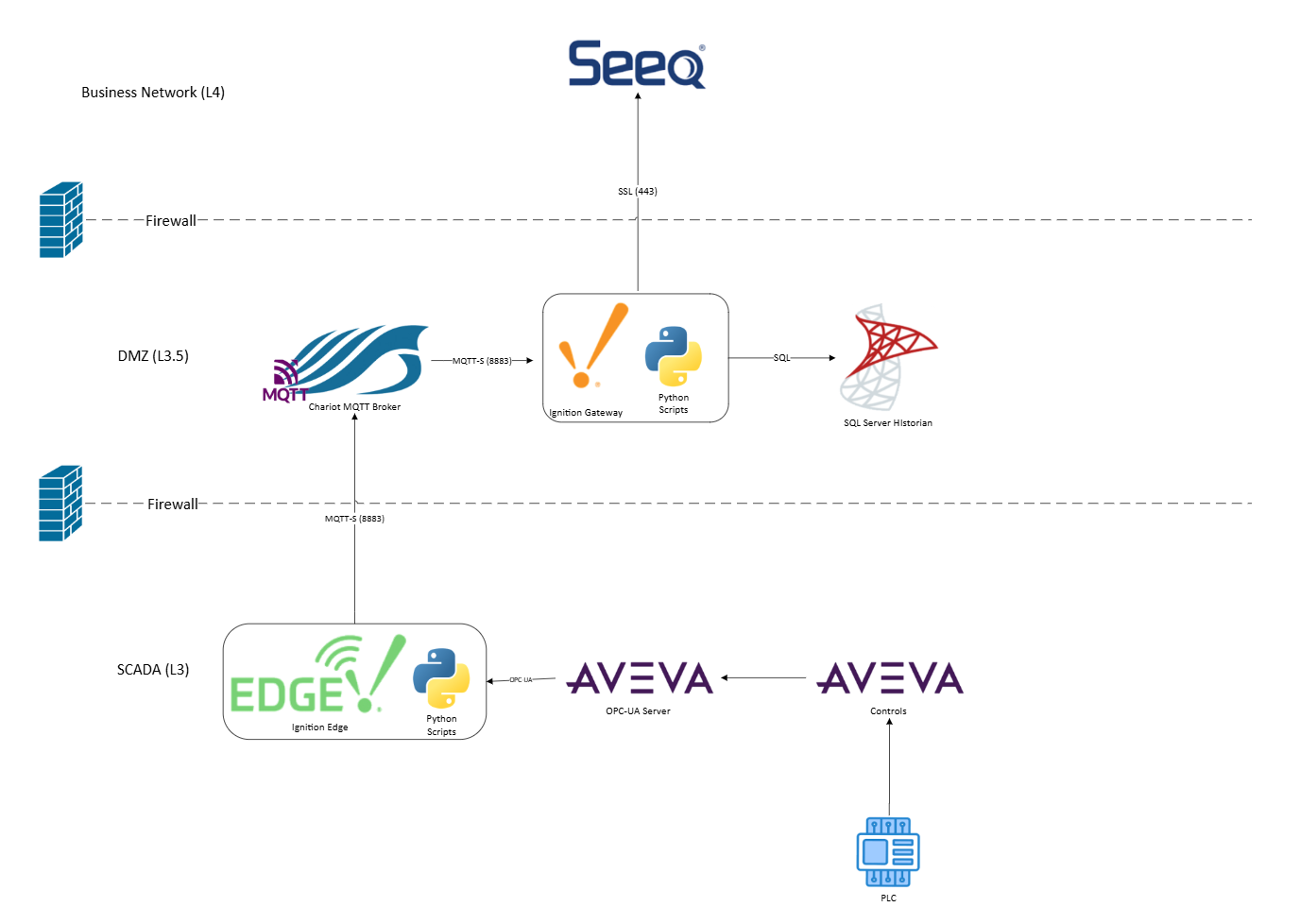
- SCADA (L3) Layer: PLC → AVEVA Controls → AVEVA OPC-UA Server → Ignition Edge & Python Scripts
- DMZ (L3.5) Layer: Chariot MQTT Broker → Ignition Gateway & Python Scripts → SQL Server Historian
- Business Network (L4) Layer: Seeq Analytics Platform
- Security: Firewall segmentation, TLS encryption (MQTT-S 8883, SSL 443), SAML authentication
Performance Testing & Scalability
| Test Scenario | Configuration | Results |
|---|---|---|
| High-Frequency Data Test | 1000 values at 20ms frequency each | No significant impact on server or database performance |
| Stress Testing Approach 1 | Independent Python script at plant floor network | Mimicked edge devices sending real-time data from AVEVA historian. Memory on the edge server became the limiting resource. |
| Stress Testing Approach 2 | Memory Tags on the Ignition Gateway changin values every 20ms using a timer script. | Validated system scalability and performance under load |
| SQL Historian Performance | Ignition's built-in historian database | Excellent performance handling high-frequency data streams. Solar winds used to monitor performance. |
Technologies & Standards
Core Platform
- Ignition (Inductive Automation): Core OT to IT integration platform
- Ignition Edge: Edge computing for local data processing
- Ignition Gateway: Central data hub and processing engine
- Python Scripts: Custom automation and data processing
Communication & Security
- MQTT Protocol: Lightweight messaging for IoT communications
- SparkplugB Specification: Standardized MQTT message format
- SAML Authentication: Enterprise SSO with Active Directory
- TLS Certificates: Encrypted communications and secure ports
Data & Analytics
- AVEVA Controls: Process control and data source
- OPC-UA Server: Industrial data communication standard
- SQL Server Historian: Time-series data storage
- Seeq Analytics: Data visualization and analysis platform
Standards & Structure
- ISA-95: Enterprise-control system integration standard
- Asset Hierarchy: Structured organization of industrial assets
- UDTs (User-Defined Types): Digital twin representation of assets
- MQTT Topic Hierarchy: Organized data routing structure
- Requirements analysis and enterprise data ops strategy development.
- Ignition platform setup and MQTT broker configuration.
- Performance testing and scalability validation with stress testing.
- Security framework implementation and SAML integration.
- Seeq integration and asset hierarchy establishment.
- Documentation and enterprise-wide standards definition.
- SAML Authentication: Implemented SSO allowing each site to manage roles using Active Directory groups.
- TLS Security: Established secure connections using TLS certificates and secure ports.
- Firewall Segmentation: Multi-layered security with DMZ and business network separation.
- Secure Protocols: MQTT-S (8883) and SSL (443) for encrypted communications.
- Role-Based Access: Centralized role management through Active Directory integration.
- ISA-95 Compliance: MQTT topic hierarchy and Ignition tag folder structure follow ISA-95 standards.
- SparkplugB Specification: MQTT messages structured following SparkplugB specification for interoperability.
- Digital Twins: Ignition UDTs represent assets as digital twins with structured measurements.
- Asset Hierarchy: Structured organization visible in Seeq for analytics and visualization.
- Enterprise Standards: Established foundation for consistent data ops across the organization.